Saturday, 9 January 2010

Lightweight!!

....was the simple message I got from Robert after telling you all that I didn't take any pictures of the change that we made to the table layout......cheeky so & so!

Anyway, attached to the message, short and sweet though it was were these two images. The first shows how we moved the tables forward at one end creating a sloping arrangement to try to keep the visitors away from all the ash that the charcoal was making.....which seemed to do the trick

moved tables


The second shows Dave trying to get some feeling back into his toes during a quick tea break....thank heavens for central heating eh?

Dave risks chilblains


As for this last one, this is one I took.....shows you what happens when you take 2 tired interpreters, then add a long cold day, a bottle of booze and a box of chocolates with clear wrappers....

Oh dear God!!


.....trust me, there is no "why" to this picture, just don't ask OK!!

Wednesday, 6 January 2010

Another One Bites The Dust.

Well, in case you hadn't guessed by now, that's another Christmas event done and dusted.....and to be honest there's a big part of me that says 'thank God that's over!'

Why? Simply because it was too long at too low temperatures....yes we can take breaks, yes we keep warm by drinking tea in our office at regular intervals, but after a while it really drags working in temperatures in single figures.....having to warm up after processing the cold meat, having to warm up after rubbing butter in, having to warm up.....well you get the idea. On top of that, the cold seeps into you and I swear that it slows the brain down, thinking gets harder and answering the demanding level of questions that we are now accustomed to can really push your faculties to the limit....or was it just slow old me?

On reflection we should have changed the format of the days, not eaten a meal sitting in the cold but changed the display into something else, but that's always the thing with hindsight....20/20 eh! Still, all our visitors seemed to go away happy and apart from a few tetchy spats after hours, I think we got away with it fairly unscathed.......my apologies to the team for my short temper towards the end of the week....I'd simply had enough and struggled to get to the last day....sorry.

I never did get to take the picture of the revised layout for you....sorry, in fact I hardly took any, still got to take the few I did take off of the camera, if there are any worth showing you all I will, but don't hold your breath folks.

I believe Robert has been asking Marc H and Robin for some stuff for his next posting and he has been working feverishly on comparing recipes from different books and manuscripts so I expect to see something from him soon.

I'm still waiting for details of the coming years events so nothing to tell about the future yet, as soon as I know I'll pop some dates and details up for all to see.

TTFN

Wednesday, 30 December 2009

It’s C C C C Cold…..

Cripes it's been cold over the last few days standing in the kitchen! Not cold enough for ice or snow, but the bitter piercing cold that we get that creeps in through your feet and saps you're spirit….still, a nice excuse for a warm cuppa and a nip at the end of the day eh?

Not a massive amount to report to you all out there, as has been the case for most of the year…..we've broken some pots (sort of intentionally, hopefully more to tell you when the official report is written on that), we've tried the odd new recipe (which I would expect Robert to write about in the New Year), we've eaten some good food and we've talked to some very nice visitors who have asked some very taxing questions…..which has helped to take our minds off the temperature.

A subtle problem has arisen with our charcoal though which has meant we have had to slightly re arrange the kitchen layout to try to keep the excessive ash that it is producing away from our visitors so they don't leave the building as filthy as we now seem to be…..if I get the chance I'll take some pictures of the changes to the layout so that you can see…..technology has defeated me though, so I won't be able to post the pictures until I get back to the real world next week.

I'm not expecting to post tomorrow as I think we will be fairly busy in the evening, so I'll take this opportunity to wish you all a happy new year and to say thanks for sticking with us over 2009, here's to more posting throughout 2010.

TTFN and please remember to drink responsibly tomorrow night!!

Sunday, 27 December 2009

As Noddy Holder Is Known To Say....

..It's Christmas!

So here we are, at the start of an 'old school' 8 day long Christmas cookery event....leaving aside the why and wherefore of my lack of posting (and to be frank my lack of interest), what's the s.p.?

Well, today was nice and busy...just the right number of people to keep us talking all day but still let us cook the planned meal, all of which was pretty good, especially the perre which was outstanding....and the roast beef was to die for.
No great adventure or surprises for the first day....keeping it simple to ween us into the work....but we will be cooking some new (to us) recipes a bit later in the week....fingers crossed I'll let you know more about them when we get to them.

I'm keeping this short and sweet as it's cold and posting involves:
1) Eating into valuable drinking time.
2) Standing in the cold garden in order to get a mobile phone signal!!!

So, as the younger generation used to say......Laters.

Thursday, 24 December 2009

Vyande de Cipres

A veritable essay from Robert ;-) ........there are accompanying images to this now over at Flickr.....enjoy!


For four days, spread over three cookery events, we devoted rather a long time making rather ordinary looking, rather gooey sticky sweet things. Next to the great roasts, vyande de cipres may look a bit underwhelming; but making it became one of the most interesting, and perhaps important experiments we have undertaken.

It's one of those recipes that occurs early on; it is mentioned in the first english menu, thirteenth century, and can be followed up through the years, changing a bit each time. It seems to be an anglo-norman innovation; Hieatt and Butler couldn't find a french source version, despite its name. 'Vyande'; meat, food, and 'cipres', meaning sweet, as Cyprus was known as a supplier of sugar. Sweetmeat. Although the oldest recipe has almond milk, rice flour, ginger and, bizarrely, pistachio nuts; but no sugar. The sweetness is provided by gingerbread, made from breadcrumbs and honey, although as it is strewn over the unspecified combination of the other ingredients, it wouldn't strike us as being overly sweet. Or would it?

Ever since food history has been taken seriously, the big question has been how these dishes tasted to the diners of the past? For example, the recipe above says to add ginger so 'that hit smacche wel of the gynger'. When spice was rare and expensive, what does that mean? It also states that it is the colour yellow, without saying how.

The other versions of this become more complicated, introducing meat and more spices. In the Forme of Cury it's dates, mead or sweetened wine, unspecified spice powder, then thickened so that it is 'stondyng'. If you are in the mood, and it is out of lent, add boiled chicken and pork... Not bad, but the thing to remember about the Forme of Cury, is that it's not just one book, but a group of manuscripts. The chosen version in 'Cury on Inglysch' is the one above, with dates. However in other manuscripts, which are all 'Forme of Cury', the dates are missing, instead we have; 'ootmele', 'mele', melis', 'me dates', 'damasines'. We are still asked to pike out the stones though; works for the damsons or plums, not so useful for the oatmeal. Pegge's in 1780 had 'oot mele', and the excellent online version posted by John Rylands University Library has 'mele'.

Our usual one, from 'Two Fifteenth Century Cookbooks', in it's turn, a bit more detail, Wine, suger, ginger, galengale, canel, parsely juice, rice flour, ground chicken and egg yolkes. And coloured with saffron and sandlewood. Even this one is a bit unformed, there is an instruction to make it 'chargeant', but is is unclear whether the rice or the eggs are responsible.

Recipes like this are are so frustrating, they are obviously meant to be special and expensive, but the absence of quantities and method makes it difficult to do them justice.

So when we realised that we had a measured recipe for the 'Vyande', would this mean that we had a clue at last to how sweet and spicy these dishes really were?

The collection that it is part of was published in London by Richard Pynson in 1500, and is obscure enough to have earned itself a rather legendary status. It is not, however, quite the missing link between the mid 15th Century manuscripts, and the popular Elizabethan cooking books, that we thought it may have been.

It's a printed version of an existing manuscript, and is almost identical to the manuscript edited by Robina Napier in 1882. First pointed, out I think, in the introduction to the Austin 'Two Fifteenth-Century Cookery Books, 1888, and by Hazlitt, but unremembered since, perhaps. The 'Napier' as we have named it among ourselves, is now available to study on the excellent 'Medieval Cookery' website.

The 'Napier', and the 'Pynson' both start by describing themselves as a 'noble' book, for a princes household, and then list the dishes at a feast by Henry the Forth. The 'Pynson' then does the same for a few more impressive feasts, including an enthronement of a Bishop of London in 1407. Very much like the late medieval cookbooks. Then the books come together with the enthronement of the Archbishop of York, named as Neville by 'Napier', dated to 1465 by 'Pynson'. This is the feast explored at some length in Warner's 'Antiquitates Culinariea', 1791, or it should be; the dishes don't seem to match...

Robina Napier is of the opinion that the handwriting of her manuscript would, 'but for the mention of this feast, point to an earlier date.'

Anyway, back to the Vyande de Cipres, there are two recipes in the 'Pynson', and one is common to both books, and is of the 'meaty' variety, in this case capon or chicken. Boiled and ground, cooked with almond milk and starch or rice flour, coloured with saffron, seasoned with sugar and 'florysshed' with almonds.

So, we still don't know exactly how this is supposed to be, sweet and chickeny presumably. At least the yellow colour is explained this time.

Right at the end of her book Mrs. Napier informs us that according to a contents list there are 'twenty-seven recipes unfortunately wanting in the manuscript'. Luckily, these twenty-seven are not missing from Pynson's version.

Which is brilliant; there are some very interesting recipes in these twenty-seven, I got rather excited about 'Potage of Ynde', surely not a fifteenth-century curry! Not I'm afraid, it's indigo... mmm...

But the one that all this is leading up to is... 'For to make vyande de cypres for xl messe'.

So it's the Vyande again, but this one has quantities, not for all the ingredients, but useful enough; so will we at last have an indication to how sweet and spicy something is? Here it is in full...

'To make viande de cipres for fourty messe / take viii. pounde of pruynes & ii. galons of vernage and make therof a thicke mylke / than take iii. pounde of dates & bete them in a morter but perboule them fyrst with vernage & drawe it up with a wide streyner & put the mylke in a potte & sette it on the fyre to boyle & caste therto iiii. pounde of suger cipres & a quart of pouder ginger half a quarter of canell drawen through a cloth wt wyne than take floure of rise drawen with wyne & put al in the pot & stire it togeder and colour it lightly wyth saffron & salt it & dresse v. or vi. leskes in a disshe for a lorde and take suger plat Rosenyg / and pouder og gynger medled with sugar & serue it'

Wow, measures! For the first time our tudor cooks have a chance to make something with a clue to how sweet and spicy a dish is supposed to be. Robin and Marc were getting rather excited about this and couldn't wait to have a go.

First the calculations had to be done... We used the american gallon of eight sixteen ounce pints, 3.78 litres, although 3.67 may be closer to the fifteenth century gallon; when we do it again we'll find out a bit more about this. And how many people is forty messes, a mess could be four or six people; we took it to be four, this of course will only affect the amount of sugar and spice per person, not the overall sweetness, etc.

So, per mess;

Prunes 3.2oz 90g

Vernage 6.4floz 181ml

Dates 1.2oz 34g

Sugar 1.6oz 45g

Ginger 0.1oz 2.8g

Canel 0.05oz 1.4g

That is 11.3g of sugar per diner; which is a heaped dessert spoon, already we can tell this is going to be rather sweet! Especially as vernage is sweet wine anyway. Very roughly, using the prices of goods from the time of Henry the Eighth quoted by Pegge, the price per mess is about 2 ½ d.

Incidently, this is the only version that calls for 'suger cipres', was this really a commodity of the time, since the the thirteenth century when these 'Vyande de Cipres' recipes first appeared? Was it added as part of the revision process as these recipes were 'updated'? This raises the question of what these recipes actually are, even whether they were meant to be made at all... A question for another time, perhaps...

Saturday 24th October, Robin had a go. We weighed out the ingredients, enough for two messes. The first part looks quite straightforward, at first make a milk of the prunes and wine. Then beat the dates in a mortar, but by the way, boil them first, does this mean the prunes too? Why the wide strainer; as in coarse, for texture, or very wide as a quick way to remove the stones, could save time when making a dish for 120 people. Added ginger and cinnamon, and the rice flour with some extra wine, and heated to cook the rice flour. As usual, just when things are looking well, something crops up, in this case the saffron to 'colour it lightly'. But this is a mush of prunes and dates, how can this be coloured in any meaningful way with saffron?

Turned out very interesting, it was too sticky to make convincing slices, but it was very sweet, and very gingery. Not very impressive looking, but it was our first taste of how sweet a sweet dish was supposed to be. We thought that if people in the past hadn't had a diet heavy in sugar since they were born, like us, their sweets would seem to us rather insipid; not so!

Next day, having seen the first version, both Robin and Marc rolled their sleeves up, and made separate dishes, trying different techniques from their years as historic cooks. As the details are rather important, and my notes don't really do them justice, I'll get in touch with them first, and get their methods properly recorded, as things got a bit complicated!

Thursday, 26 November 2009

Fylettys en Galentyne.

Another post by Robert to keep things moving along! Enjoy and why not have a try at home?


November, and the winter nights are getting longer, it may be time to think about one of our favourite dishes, part of our menu on Sunday 27th of September. Yes it's fylettys en galentyne, a good dish for the chillier weather, and one of the history recipes that our cooks regularly make at home.

Well, it starts promisingly. 'Take fayre porke, the fore quarter, an take of the skyne; an put the porke on a fayre spete, an rost it half y-now'. This is how we usually do it, put pork on the spit in front of the fire, until roasted a bit more than half done; but on the 27th we put our pork fillets on a griddle over the charcoal stoves. To see what would happen, really...


Fyletes are defined in a note in the Forme of Cury as 'that buth [be] take oute of the pestels [legs]', leg of pork. And another note says 'The loyne of the pork is fro the hippe boon to the hede.', which is similar to the modern term; the modern cutting diagram shows the loin ending about half way to the head. Although the fillet of pork is now a tender cut of the loin; tender because these muscles are 'not used for locomotion'.


Our recipe calls for the front quarter, so we tend not to be too fussy, we usually choose a joint we can get on the spit. Then half roast it, a Forme of Cury version says 'till the blode be tryed out'. And this time we didn't go to the trouble of using the spit. As this dish is so popular with us, we wanted to see how it would turn out making slightly less of a performance of it, hopefully to show our visitors that it could be made at home.


Our recipe continues fairly straightforwardly, cut up the pork, put in a pot (to be fair, it's 'fayre pecys' and a 'fayre potte'). Fry medium cut onions in a pan, and put them with the pork with beef or mutton broth. Add ground pepper, canel, cloves and mace, and boil well. We then thicken with bread, add vinegar and simmer for a bit longer. The recipe says 'tak farye brede, an vynegre, an stepe the brede with the same brothe, an strayne it on blode, with ale, or ellys sawnderys, and salt, an lat hym boyle y-now, an serue it forth'.

I've bothered with this bit because even when a historic recipe is going well, something a bit strange crops up... Blood, ale or sandlewood?


There is a simpler version from the Forme of Cury; 'Drawe a lyour (thickening) of brede and blode and broth and vyneger, and do therinne'. Then boil and add pepper and salt.

Unsurprisingly, the Forme of Cury has also a more complicated version; it goes on a bit, highlights include using bread crusts ground in a mortar, boiling the pork to make it more tender, and adding pepper, sandlewood, parsley, hyssop, red or white wine, grease and raisins.

So there is some scope for making it at home; both Robin and Marc have done this, and I have persuaded them to share their tips...


Marc likes to fry the pork steaks (about half an inch thick) until they start to brown, then fry the onions (three good sized ones for six people) in the pork fat, and put the whole lot in a casserole dish. If you don't have a stock, make one up from stock cubes, beef or lamb, and vegetable, made a bit stronger than usual, de-glaze the pan with it, and add to the dish. Add the spices, ground pepper, mace, two or three cloves and, Marc being a purist, ground cassia. He buys his cassia from an asian supermarket, where it is called 'dalchini'. He uses, as we all do, Robin's method of assessing the spice mix by smelling the mixture, and if one scent predominates, then adjust to make it more harmonious.

Ten or fifteen minutes before ready, take a ladle full of stock and soak bread in it, add vinegar and return to the pot to thicken.


Robin's version is similar, except he likes to grill (broil) the pork, only uses salt and pepper to season, and reduces the mixture by simmering in a saucepan. It really is very easy!

And I find it a useful way to make something nice from left over roast pork.

How about a version we haven't tried yet? This one is from 1500, and with the white wine and ginger should be interesting. I'll quote it in full, in case anybody would like a go...


To make fyletts in galentyne take the beste of rybbes of porke & flee of the skynne & rost the fleshe tyll it be almost ynough than take it of & chop it in peces & put it in a potte with onyons butter or fayre grece and hole clowes maces quibybes and do it togyder with a cruste and trye it through a streynor & white wyne and do therto pouder of peper and put it in the potte and when it boyeth lette it not be chargeaunt & season it up with pouder of gynger & salt & serue it.


So; good luck!


griddling pork


the finished dish


Thanks Robert for that, I have to say that the recipe is genuinely idiot proof.....we really have never had a failure with this dish, yes some are better than others, but I think it would be fair to say that this is one recipe that we rarely have any left-overs at the end of a meal!

The keen eyed amongst you, well those that look at the stuff on the right hand side of the page at least, will have noticed that we'll be in action again this weekend; the last event before the big Christmas blow out!

Lots of roasting things planned for this last weekend along with a few other treats to keep Robert in writing for some time to come....perhaps we'll even persuade Marc H to write something too!

TTFN

Wednesday, 4 November 2009

Strawberye.

So folks, here's another post from Robert.......enjoy!


Still on the 26th of September, I had better speed up a bit: there has been another weekend since my last post, so now I'm heading in both directions at once! Even the recipes that look simple, aren't...

Strawberye is basically strawberry juice thickened with flour. But let's take the first line, 'Take Strawberys, & waysshe hem in tyme of ere in gode red wyne'. Could mean wash before doing the other steps, or, as Marc H suggested, time of year; when they are ripe. And 'wash', sometimes a recipe says something like 'wash it clean', obviously the modern usage. Sometimes in the sense of 'clean' or pitted. Neither works in this case; perhaps some way to 'freshen up' the fruit? The wine being 'good' sounds rather like it's an ingredient.

Then 'strayne thorwe a clothe', Marc now does this by putting the damp strawberries whole in a cloth, really squeezing then twisting to get all the juice out.

Squeezing Strawberries


'& do hem in a potte with with gode Almaunde mylke'. Right, now we have another recipe to look at! Marc made this from scratch, as there was a burner available, and he felt like it.

'To make gode almondys mylke', sugared water boiled and cooled for a bit, then add ground almonds. Of course it's a bit more complicated than this... Marc said it went milky very quickly this time. Pre-ground almonds were used.

Now the thickening part, 'a-lay it with Amyndoun other with flowre of Rys, & make it chargeaunt and lat it boyle'. A handful of rice flour was used. Sometimes there is a clue to the thickness; not so 'chargeaunt' so it can be poured from the bowl, for instance, but not in this case!

Cooking Strawberrye


Then add currants, saffron, pepper, sugar ('grete plentie'), ginger, canel and galengale. Here we have another complication; 'canel'. This is usually taken to mean cinnamon. But there are recipes that call for cinnamon and canel...

We have wandered into an area that is being disputed by historic cooks. There are two candidates; proper cinnamon, delicate and sweet, and cassia, not so delicate and sweet. Both spices are mentioned in the bible, appearing together in an oil to anoint the ark, (no, not that ark, although some fragrance would have helped, I imagine...).

There is a fifteenth century hippocras recipe that has two versions; the 'lord's' has cinnamon, and the 'commoners'' has canel. Marc has adopted a zero-tolerance policy: always using cassia for 'canel'. One history of spice textbook, while examining in detail the cinnamon/cassia debate, sidesteps the issue by not even having 'canel' in the index. I expect the blog will go into a lot more detail about this as we go through the year: any comments?

Now, typically, punctuation complicates things. After the list of spices it continues 'poynte it with Vynegre, & a lytil whyte grece put ther-to; coloure it with Alkenade, & droppe it a-bowte, plante it with the graynys of Pome-garnad, & than serue it forth'. Reading the semi-colon in the modern way, the fat goes in with the spices and vinegar, and the whole thing coloured with alkanet. You need a lot of alkanet to change to strawberry colour... It does make more sense to colour the fat with the alkanet, which is fat soluble. Marc says the coloured drops of white fat should be strewn about the surface like glistening orangey/red jewels...

Finished Dish


A good berry to choose, as Andrew Boorde says: 'Strawburyes, be praysed aboue al buryes for they do qualyfye the heate of the lyuer, & dothe ingender goode blode eaten with sugar'.

Yummy!

Along with all the above that Robert sent for posting, he also included the picture below.....I'm guessing from Halloween but it could just as well have been from the Palace Ghost Tour on the Sunday night......perhaps I should have asked him eh?

TTFN.

West Front Pumpkins

Friday, 9 October 2009

New Pictures!

To go with the post below, Robert also sent 9 pictures which are now there for all to see at Flickr......just follow the link on the right to get there!

They include these gems.....

Robin and a Chicken


Strawberries


Ryse of Genoa

Blimey, The Blog!

was the subject line of the email from Robert as he sent me his copy for this posting. He knows that he has the login and posting details, but he's an old fashioned chap and likes to run it all through me first....bless him ;-)

So, here are his words.......

Hello again!

For most of the summer I have been meaning to update the blog, but the further away you get, the more difficult it becomes to catch up. So, like the usual desperate twist in generic science fiction, how about taking the year backwards? The advantage; at least we can remember what happened last weekend. And the other advantage is that as the blog goes deeper into the past it will get even more out of joint, and possibly slightly surreal...
Although, the year has been rather strange anyway, with a wedding every day and tournaments, coronation celebrations and all sorts of revels. Usually the music plays in the distance and the boys peer forlornly up at the small patch of blue that we call the sky... but for a couple of times we were released from the vaults and frolicked like pit-ponies in the sun...
Well, that wasn't such a good image after all, just as well last weekend was a 'normal' one.

Saturday 26th September.

For a change, we repeated something! As we are trying to be serious about our research remit, we have been doing a lot of measuring. We have tried a few approaches, but it's not easy to know where to start. So, we chose something that is reliable to do, gives proper figures and doesn't second guess 'interesting' results. Every main meal, the 'supper' in the afternoon, has the food weighed before and after. The idea started when we were trying to work out the 'bouch of court' meat ration, not as easy as you might think as the quantities recorded are monetary, not by weight.

When Richard had worked it out, it seemed an awful lot, and that got us thinking about how much we ate anyway. Although it is something we have vaguely wondered about since we started, as the style of Tudor dining; just taking what you want, in small portions, over the course of the meal, does mean you lose count, and only stop when you are satisfied. Or think you are. A bit like surfing a buffet and only later realising one is too full for beer. Not that this happened to me at Ross's wedding...

So to have a set of meaningful figures we decided that the September cooking weekend would feature the same dishes as we had in July. Time's arrow will explain why we chose these dishes in the first place, as the blog moves deeper into the past... It turned out to be an interesting experiment; we usually try to vary what we cook, and having to repeat a whole day gave us a chance to make the dishes even better.

Roast Beef
Salmon Fress Boiled
Capon Stewed
Ryse of Genoa
Strawberye

Of course we have to have roast beef, and it was as good as always, we ate an average of 130 grams each; a modern restaurant portion is around 100grams.
The salmon was roasted on a gridiron, then boiled with parsley and salt, then served with a garnish of parsley leaves wetted with vinegar, we managed 50 grams of that.
We had to use chicken for the capon stewed, as it isn't easy to get capon nowadays; capons are made, not born, unfortunately [now you remind me Robert, we might be able to get some sorted for Christmas]... But this is a great recipe: stuff the chicken with roughly broken herbs and put it into a pot, which has 'broken splints' (we used wooden spoons) placed inside so that the bird 'touche no thinge of the potte'. Then put in herbs (including hyssop) and some of 'the best wyn that thou may gete and none other licour', the lid is sealed on with sticky dough 'that no eier come oute' and put on the stove 'easly and longe till hit be ynowe'. Then make a sweet, fruity syrup with the wine and 'powre hit on the capon'. Chicken steamed in wine; well of course it was nice!
Ryse of genoa is one of our standards, it turns up in about one in four of our cooking days over the last few years, being a useful non-meat dish. This time it was particularly good, one of the bowls was completely finished. Thought it may be interesting to go into a bit of detail into the making of this sometimes overlooked staple.
'take Ryse ans seth them in fayre water ans stepe them well And take hem of and caste them in A fayre vessell and pyke them clene and set then on fyre A yene'. Does this mean the rice is boiled before any stones and husks are removed? A similar recipe from a 1500 book is more explicit; 'To make ryse, pyke youre ryse and wasshe it in [two] or thre waters and late the water be warme', an older Forme of Cury version is typically direct, 'Take ryse and waisshe hem clene'. Our recipe goes on, 'And do ther to broth of freshe beef or of mary bones and let hem seth well And do there to grownd safferon & salt and if hit be fastyng day temper hit with Almound mylke & serue hit forth.'
Boiled twice? The Forme of Cury version just has the rice boiled in stock. The 1500 book recipe is less vague, 'And boyle hem in clene water and at the first boyle put out the water clene and boyle them with the brothe of flesshe or with brothe of fresshe fisshe and put therto sugar saffrom and salt and serue it'. We know that this dish is more like risotto than rice pudding, because it would say so; compare with another Forme of Cury recipe for a pottage of rice which has, 'and seth hem tyl they breste [burst]'
So how did Robin make it so good? This week I secured an exclusive interview with the Maister himself...

He said that as we have been making it so long he has tried all sorts of rice, long and short grain and in the early days used stock made up from stock cubes (one beef, one vegetable, made up to double strength). This weekend he used stock he had made earlier this year, at one of the events when we didn't do much cooking. Beef bones and trimmings simmering in a cauldron all day until it had reduced from a gallon to under two pints. When cold, the fat skimmed off, and then frozen to use later.
This time he used arborio risotto rice, the label said, 'bold, white grains characteristic of Milanese rice, typical of northern Italy', (presumably Genoa being the port where the rice was exported from; none of the other rice recipes gives even a clue like this what type of rice is intended to be used). Wash the rice, and boil in plenty of water until half cooked, then refresh in cold water. Bring the stock up to the boil, add the rice and boil together, and try to absorb as much of the stock as you can. Robin adds the saffron as a solution; dry it over the stove on a spoon, then grind it fine in a mortar, which is washed with a little water which you then add to the rice. Try it for saltiness before serving, this time the stock was so concentrated, it didn't need any added salt. It was rich and tasty, and, as I may have mentioned, one of our messes finished the whole bowl, unusual for a dish we know so well.
The last dish was strawberye, which also involves rice, this time as rice flour to thicken. It too was much appreciated. As I have gone on a bit and Richard has described the process before in the blog, I'll leave strawberye until I can interview Marc H and get the low-down on what made it so good this time.

Next time, Sunday; and the return of the poumes!

Monday, 28 September 2009

Panoramic Archive

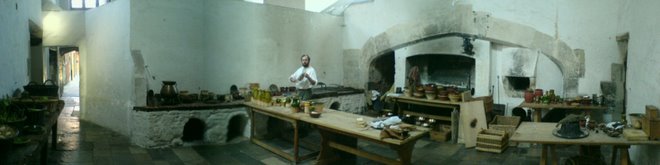
Well I think I've sorted out the hosting issue for all the old quicktime panoramic images.....let's see if this works then:

With all three you just need to click and drag the image around...I'm sure you'll all work it out.

The first is the Kitchens...


This one is Clock Court, this is when there was renovation work being done on the whole clock tower...


and finally a piece of history, Base Court as it no longer looks! I took this before the work started on re-paving the courtyard....I must get round to doing a newer version, but given that the nights are now drawing in this may have to wait until next year now....still, enjoy this view of the past...


It turned out that the rest of the stuff on the soon to vanish hosting site was the video of a boiling pot, which to be honest, out of the context of the post is really dull....along with the various menus that I've posted in the past. Although these may be interesting they really do need to be linked with the post about them and I just can't face sorting that out at the moment....perhaps in the future but for now they'll just have to vanish into the ether.

TTFN